
Mint Road, on December 21, 2023, flagged the role of self-regulatory organisations (SROs) in strengthening the compliance culture in regulated entities (REs) and providing a consultative platform for policymaking. It also decided to issue an omnibus framework for SROs.

World Bank president Ajay Banga is among the Indians who have made it to the prestigious Times's list of 100 most influential people in the world released on Wednesday. Time's profile of the former Mastercard CEO, written by US Treasury Secretary Janet Yellen, said, "It's not easy to find a leader with the skill and drive to take on the monumental task of transforming an essential institution, but since becoming World Bank president last June, Ajay Banga has done just that." She said Banga comes to the World Bank after leading a global organisation through which he brought millions of unbanked people into the digital economy.
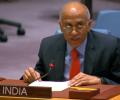
India's Permanent Representative to the UN Ambassador Parvathaneni Harish said that the Indian sub-continent offers a "stark contrast" in terms of progress, prosperity and development models.

'If you align your ambition with India's rise, the peak of your careers will unfold alongside the peak of India's power.'
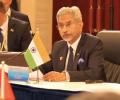
Jaishankar said the UN Security Council condemned the attack and underlined the need to hold perpetrators, organisers, financiers and sponsors of the reprehensible act and bring them to justice.

Tech titan Google on Thursday announced new online safety initiatives in India, including multi-city cybersecurity roadshows to upskill about 100,000 developers and digital safety-focused grants of $2 million from Google.org to community organisations.

'We continue to view India as a standout within EM.'

UN General Assembly President Philemon Yang will visit India from February 4 to 8, his first official trip as President of the 79th session. Yang highlighted India's "remarkable transformation" over the past decade, particularly in digital and technological innovation, and plans to see how these advancements have reached the grassroots level during his visit. He also praised India's contributions to peacekeeping, humanitarian efforts, and its voice for the Global South.
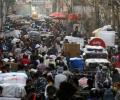
For India to transform into a high-income country with a projected gross domestic product (GDP) of $23-35 trillion, will need a sustained annual growth of 8 per cent to 10 per cent. This will be powered by India's demographic dividend, technological innovation, and sectoral transformation, according to the "India@2047: Transforming India Into A Tech-Driven Economy" report by Bain & Company and Nasscom. By 2047, the services sector is expected to contribute 60 per cent of India's GDP, while manufacturing will account for 32 per cent, both playing a pivotal role in economic expansion.

Even at the entry-level, professionals who have proficiency in emerging technologies will have an edge over others in these domains.

Prime Minister Narendra Modi asserted on Tuesday that India's water will no longer flow outside the country but will be utilized in the nation's interest, a statement seemingly directed at Pakistan following his government's decision to put the Indus Waters Treaty in abeyance after the Pahalgam terror attack. Addressing the ABP Network's 'India@2047' Summit, Modi emphasized his government's focus on interlinking rivers, noting that water used to be a source of conflict among states, before alluding to India's stance against Pakistan while discussing water. He highlighted the finalization of the India-UK free trade agreement as a historic milestone and underscored the importance of prioritizing national interest for achieving objectives and realizing the country's potential. Modi highlighted the country's growth and development under his government's rule, emphasizing its focus on welfare schemes and digitalization. He reiterated his government's commitment to 'Nation First' and pointed to the recent reforms undertaken, including the new Waqf law and the ban on triple talaq, which he said were aimed at benefiting the marginalized sections of society.

India will place restrictions on foreign direct investment (FDI) in the national interest to ensure safeguards because of its location in a highly sensitive neighbourhood, Finance Minister Nirmala Sitharaman said during an interactive session at the Wharton Business School in the US on Tuesday. "I cannot blindly accept FDI simply because we need investment, unmindful of where it is coming from. "We want business, we want investment, but we also need some safeguards, because India is located in a neighbourhood that is very, very sensitive," Sitharaman said.
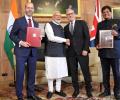
'That way you're not hostage just to US sort of exports to India.'

Reserve Bank of India (RBI) Governor Shaktikanta Das said on Friday said the central bank has developed an innovative artificial intelligence and machine learning (AI/ML) based model MuleHunter.ai to address the growing issue of mule bank accounts that are often used for committing financial fraud. Developed by the Reserve Bank Innovation Hub, the new initiative is piloted with two public sector banks.

Jaishankar said such a description would be like putting the perpetrator and the victim of the Pahalgam attack at the same level.

The government fully supports foreign and Indian companies in leveraging Internet as "force of good" but will take all measures to ensure that Internet remains open and is not dominated by some big corporates, Minister of State for IT Rajeev Chandrasekhar said on Wednesday. Chandrasekhar said the government wants to make sure that intermediaries and the big platforms such as Meta (formerly Facebook) and others develop a culture of mutual respect and accountability between the platform and its users. "And we also want to make sure that given that a billion Indians are going to be there... women, children, elderly, pensioners, all of them, that the internet is also safe and trusted.

The interplay between domestic and foreign capital will shape India's equity markets.

Confident of securing a massive majority in the upcoming Lok Sabha elections, Prime Minister Narendra Modi on Wednesday outlined his vision for his next five-year term saying the Modi 3.0 government will put all its might to strengthen the foundation of 'Viksit Bharat' or a developed nation.

After Chennai, it is Coimbatore, Madurai, and Tiruchirappalli, that are emerging as manufacturing hubs. Coimbatore is India's top Tier-II city in terms of the number of GCCs, according to a report by Cushman & Wakefield.

"The theme of tomorrow's meeting is 'Economic Policy Reform, Road Ahead'. The prime minister will make opening remarks. There are 15 invitees who will make their presentations before the prime minister," a senior government official said.

'Its nature changes, new types of jobs are created.' 'We need to invest in skilling and re-skilling our people for an AI-driven future,' Prime Minister Narendra Modi said in his opening speech at the AI Action Summit in Paris, co-hosted by India.

Are we running a cricket match using football rules, asks Ajit Balakrishnan.
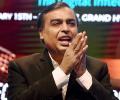
Billionaire Mukesh Ambani on Monday pressed for bridging the digital divide "both among nations and within nations", saying connectivity and communications have become the fundamental rights of every person. Also, there is a need to bring back the economies around the globe. Speaking at the Qatar Economic Forum, he said it is difficult to imagine what India would have been without the 4G telecom network during the pandemic. "The digital divide must be bridged, both among nations and within nations.

Isn't there something significant in the UPI example for all of us to learn from and execute to enable world-scale success for our startups?, asks Ajit Balakrishnan.
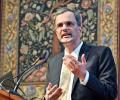
There is a "misperception" among the administration around deregulation, wherein digitisation is confused with deregulation, Chief Economic Advisor V Anantha Nageswaran said on Tuesday. Speaking at an event organised by alternative investment industry's lobby grouping IVCA in Mumbai, Nageswaran stressed that what is essential is to do away with needless regulations, whether they are to be complied with online or offline.
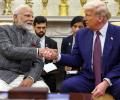
'I certainly hope the two can avoid a trade war and believe they will.' 'I expect some in India will push for retaliatory tariffs if the Trump administration applies significant reciprocal tariffs.'

While India won't be immune to global spillovers, we need to create the macro preconditions for sustained growth. Policy agility, prudence, and resilience will be key, suggests Sonal Varma.
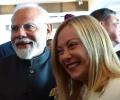
Prime Minister Narendra Modi held a series of bilateral meetings with his global counterparts on the margins of the G7 Summit in Kananaskis, with discussions focusing on a range of issues such as trade, investment, counter-terrorism and global challenges.

Lee Jae-myung's decisive victory in South Korea's snap presidential election marks a major political shift driven by public backlash against authoritarian, with significant implications for domestic reform and the future of the US-South Korea alliance, observes Dr Rajaram Panda.
'Binary fission will happen -- startups will lead to more startups.'

Nine Indian universities and institutions have secured a place among the world's top 50 in the QS subject-wise rankings, with the Indian School of Mines (ISM) Dhanbad claiming the highest position at 20th globally for Engineering-Mineral and Mining. Despite the success, some top institutions, including three IITs, two IIMs and JNU, have experienced a drop in their rankings. The QS World University Rankings by Subject, in its 15th edition, highlight India's growing higher education ecosystem in terms of both size and quality.
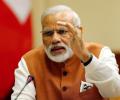
India is investing in developing indigenous capabilities in 5G and 6G telecom technologies besides focusing on manufacturing semi-conductors, Prime Minister Narendra Modi said on Thursday. In a virtual address at the Sydney Dialogue, the prime minister said the "greatest product" of technology today is data and that India has created a robust framework of data protection, privacy and security. "And, at the same time, we use data as a source of empowerment of people. India has unmatched experience in doing this in a democratic framework with strong guarantees of individual rights," he said.

India's e-commerce market alone is projected to reach $200 billion by 2026, making it a prime industry for ambitious entrepreneurs, explains rediffGURU Harsh Bharwani.

President Droupadi Murmu, in her address to the nation on Republic Day, advocated for the "One Nation One Election" initiative, emphasizing its potential to enhance governance and reduce financial burdens. She highlighted the government's efforts to eliminate remnants of colonialism, citing the replacement of British-era criminal laws with modern alternatives. Murmu also lauded India's economic progress, stressing the importance of inclusive growth and social welfare. She urged citizens to remember the sacrifices of freedom fighters and reaffirmed the significance of the Constitution in guiding India's journey towards a prosperous and equitable future.

Following are the highlights of the Economic Survey 2022-23 tabled in Parliament on Tuesday

India is poised to be the fastest-growing major economy in the world and an engine of global growth despite global headwinds, says leading industrialist and Aditya Birla Group Chairman Kumar Mangalam Birla. The economic activity in India has witnessed a sharp recovery to pre-pandemic levels on the back of a rapid and widespread rollout of the vaccination programme, Birla said in the latest annual report of UltraTech Cement Ltd. "A strong digital ecosystem, fiscal and monetary policy and various government schemes helped small and medium enterprises and the worst affected sections of the population to survive while reviving demand and bringing the economy back on track," said Birla while addressing UltraTech's shareholders.

The two sides are also likely to firm up a currency swap framework and seal several other agreements including one on debt restructuring following talks between Modi and Sri Lankan President Anura Kumara Disanayaka on April 5, people familiar with the matter said.

The US Trade Representative noted that India's average applied tariff rate stood at 17% per cent, the highest of any major world economy.
'More investors now view the stock market as a valuable opportunity, though many still seek quick gains, leading to a rise in futures and options trading.'

Currently, companies are taxed in the jurisdictions in which they have a physical presence. However, digital businesses generate revenues from markets without a significant physical presence in a country.
